Comboni Lay Missionaries

Hope School

Colegio Gumuz
Gumuz school

Our school time, especially infant and primary school, usually marks our lives in one way or another. Great memories pile up: friends who are a big part of who we were, teachers who touched our hearts and opened paths we had not even imagined until then… In general, a shared life that filled us with passion and joy and that we will almost always consider as the best stage.

However, in Ethiopia, school can have a more complete meaning.

In the region where I live, Gumuz, the Comboni family has 5 kindergartens (3 run by the Comboni Fathers, 2 by the Comboni Sisters) and an elementary school (run by the Comboni Sisters). All these centers were requested by the local government itself, more than 20 years ago, which understood that this underdeveloped region needed educational spaces that would fulfill two objectives: on the one hand, to promote education in order to be able to guarantee an autonomous and dignified future; on the other hand, to create spaces where boys and girls of all the ethnic groups present in the area could coexist, in equality and friendship, so that the division (so present and so deep in the region) would disappear from the pillars of life (childhood and adolescence) and the idea of complete fraternity would be fostered.

Gumuz school

This has been the objective of the Comboni Family all these years, from the general educational plans to the daily work: to create a place where living together is as important as the acquisition of knowledge and skills.

However, the social reality has changed a lot in the last two years. When I arrived in Ethiopia, this region was in the midst of an ethnic conflict between ethnic groups (with killings, displaced people, burning of houses, etc.). When the situation was normalizing, Covid-19 appeared to break the normality, close everything and spread panic (which had already become a regular “visitor” in this area). And, without having managed to stop this problem, a new ethnic conflict, even more serious than the previous one, struck the life of the inhabitants of the region. The problems that we found in the first conflict multiplied, expanded and knew no religion, age or sex to have a little mercy. The day to day life was dominated by a panic already known, but that reached unsuspected limits. EVERYTHING was locked again with the key of fear, violence and discouragement.

The situation demanded a response, and the school of the Comboni Sisters, which is the one I am writing about, became more than a center for living together, it became the ” Hope School”.

Gumuz school

Facing the reality of violence, many people, mainly women, children and the elderly, chose to leave their homes. Many went to hide in the forest, but the vast majority of those who lived around the school, almost instinctively, and out of enormous trust in the sisters, chose to take refuge in masse in the school. It was amazing to see how they entered by dozens, or hundreds, with the few things they could grab before escaping, in an improvised diaspora, carrying belongings, children, babies, grain, animals, etc. The school opened its doors, and became, more than their home, their refuge, since, more than comfort, they sought security. The classrooms were emptied and transformed into places to sleep, cook, eat and receive care; as well as other spaces and common areas, even the courtyards and fountains.

As the weeks passed, the situation gave some respite; people returned to their homes, but not to normality. Fearing that their belongings might be looted, they feared mainly for the grain they had collected throughout the year. They again placed their hope in the school, which once again opened its doors so that they could take the grain, in hundred-kilo sacks, to be stored in the only place they trusted at the time.

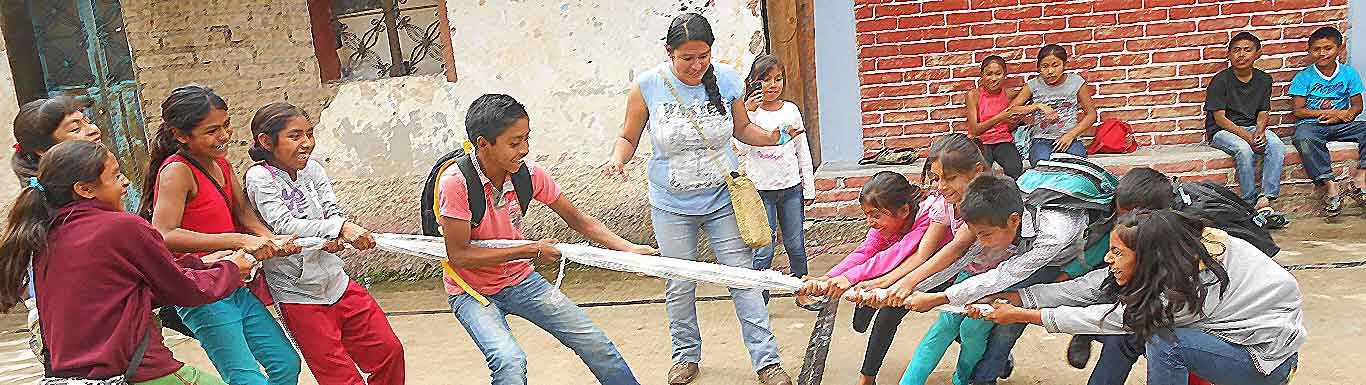
This situation was especially serious for the boys and girls, who were living in fear and feeling unprotected. The sisters, aware of this, put the school back at the service of the children, creating a space of trust. Despite the fact that officially all the schools in the area were closed, the doors of our center were opened almost daily to give tutoring and review classes, to welcome anyone who came and allow them to paint, draw, read or write; and, what was most successful, to organize (or rather, to improvise) games and sports activities. At that time, the most important thing was not that the children and young people learned or were evaluated, but that they could arrive to a place where they felt safe, excited, with the joy that should reign at this stage of life. That they could play, interact in peace and tranquility and feel embraced and comforted was the priority; in short, that they could be what they are, boys and girls, forced to grow up by a harsher reality than they should have known.

Gumuz school

Throughout this process, my missionary mate (Pedro) and I wanted to be involved to the maximum (even though sometimes it was impossible for us to move because of the danger of the ten kilometers of road that separated our house from the school, due to attacks, raids, shootings, etc.). Our daily work, our illusion and our strength were mainly focused on accompanying and helping to carry out the daily activities for boys and girls; as improvised teachers, sports coaches, monitors, chaperones, and everything else we could imagine, we tried to offer a space of welcome and hope to everyone who crossed the doors of the street.

Gumuz school

Tomorrow, February 23rd, and after having stabilized the situation, the school officially opens its doors for the new school year (having lost almost half a year). The students, from 3 years old to the end of primary school, will return to their classes. In this return, the nightmare will be behind them; and I doubt that any of them will cry at the doors of the school. On the contrary, they will be eager to return to the place from which they never felt apart; the place that was for them the only space of tranquility and carefree. Parents, for their part, will feel more relieved than ever, since, if in the moments of greatest torment they trusted blindly to protect their sons and daughters (the most precious gift they have), the return to teaching will fill them with renewed enthusiasm.

That is why, although it has another name, I have preferred to baptize it as “Hope School”.

Gumuz school

David Aguilera Perez, Comboni Lay Missionary in Ethiopia

Missionary experience at St. Paul Catholic Church of Akonoma, Cape Coast (Republic of Ghana) from 21st December 2020 to 4th January, 2021.

LMC Ghana
LMC Ghana

Our chaplain, Rev. Fr. Leopold Adanle, in his zeal to further our formation, suggested to our group to do some days experience in Manigri, Benin. Later on, after the Provincial Council, it was agreed to go for the experience in Cape Coast, Ghana.

We had to leave our families to celebrate Christmas festivities far from our residences. Early the 21st December, 2020, Frank Amenyo and Justin Nougnui started the journey from their various areas to meet Christian Wotormenyo at Accra. From Accra, the three of us took a car for Cape Coast. Cape Coast is about 300 km from our towns. The Parish Priest, Rev. Fr. Bonaventure Gnaha came to pick us from the lorry station to our station, St. Paul Catholic Church of Akonoma. The experience was in two aspects, with the Church Community and our CLM Community.

1. Experience with the Church Community

Our service was to revive the Church of Akonoma. We moved from house to house at the quest of the church members who have stopped coming to church. None of the three of us knew Fante, the local language of the area. Two of us could say very few words in Fante. We moved with an interpreter. We had the grace to visit some aged and sick members of the church and also from Akonoma’s community. After the house visitation, we planned meetings with the various societies of the church to form and consolidate them. We enjoyed the festivities of Christmas. On the 24th, 25th, 27th, 31st December, 1st January and 3rd January which were the Christmas vigil, The Christmas day, the feast of the Holy Family, the New year vigil, the Solemnity of Mary, Mother of God and the Solemnity of the Epiphany, the population at church was encouraging. The Rev. Fathers, Bonaventure, Joseph and Anthony came one after the other for the various celebrations. The 31st night, new year vigil, School of Jesus, a society of children exhibited a night performance.

2. CLM community

Monthly, we had a meeting. But for this experience, the three of us had the time to live together.

a. Prayer life

We had our daily schedule. We prayed the Laudes in the morning, read the daily Gospel with a commentary, a Life History of St. Daniel Comboni written by Bernard Ward. After the breakfast, we had our indoor or outdoor activities. At 12:30, we had lunch followed by siesta. In the afternoon we had activities, at 6:30 we prayed the Vespers, ate. Every day before the Night Prayer we reflected upon the day activities and planned for the following day.

b. Division of labour

We cooked ourselves, served the meals and washed the bowls. We fetched water ourselves sometimes, other times, the youth helped us. Each one has a responsibility, Mr. Wotormenyo the team leader, Mr. Amenyo the bursar and Mr. Nougnui the secretary.

c. Vocation promotion

We spoke about the Comboni Family in general when we met some active members of Akonoma. We laid emphasis on CLM, who they are, the requirements to be CLM, the activities of CLM. We did the same thing when we attended the parish Liturgical Committee meeting. We also took the opportunity to visit a group of Friends of Comboni at St. Paul Catholic Church of Nkanfoa. As it is now in our province, being a member of the group of Friends of Comboni is one of the requirements to aspire to CLM. We chatted with the members and encouraged them to move further to CLM. We promised to be in touch with them for the way forward.

d. The neglected

The visit from house to house showed us the reality of the neglected and the abandoned. Some aged and sick persons were a little bit forgotten. In order to continue the Caritative aspect of the Church, we created from the Church Committee the Welfare Committee. Its role is essentially to look for the sick, to find “the lost sheep” and also to assist members who are bereaved.

We are so grateful for the opportunity given to us. We thanked the Provincial Council, our Chaplain, the parish priest of St. Paul Catholic Church of Nkanfoa, the church community of Akonoma for helping us respond to our vocation. This missionary experience strengthened our faith and motivated us to continue our journey on the footsteps of St. Daniel Comboni.

Justin Nougnui, CLM coordinator.

Message of his holiness pope Francis for lent 2021

Papa Francisco

“Behold, we are going up to Jerusalem” (Mt 20:18)
Lent: a Time for Renewing Faith, Hope and Love

Papa Francisco

Dear Brothers and Sisters,

Jesus revealed to his disciples the deepest meaning of his mission when he told them of his passion, death and resurrection, in fulfilment of the Father’s will. He then called the disciples to share in this mission for the salvation of the world.

In our Lenten journey towards Easter, let us remember the One who “humbled himself and became obedient unto death, even death on a cross” (Phil 2:8). During this season of conversion, let us renew our faith, draw from the “living water” of hope, and receive with open hearts the love of God, who makes us brothers and sisters in Christ. At the Easter vigil, we will renew our baptismal promises and experience rebirth as new men and women by the working of the Holy Spirit. This Lenten journey, like the entire pilgrimage of the Christian life, is even now illumined by the light of the resurrection, which inspires the thoughts, attitudes and decisions of the followers of Christ.

Fasting, prayer and almsgiving, as preached by Jesus (cf. Mt 6:1-18), enable and express our conversion. The path of poverty and self-denial (fasting), concern and loving care for the poor (almsgiving), and childlike dialogue with the Father (prayer) make it possible for us to live lives of sincere faith, living hope and effective charity.

1. Faith calls us to accept the truth and testify to it before God and all our brothers and sisters.

In this Lenten season, accepting and living the truth revealed in Christ means, first of all, opening our hearts to God’s word, which the Church passes on from generation to generation. This truth is not an abstract concept reserved for a chosen intelligent few. Instead, it is a message that all of us can receive and understand thanks to the wisdom of a heart open to the grandeur of God, who loves us even before we are aware of it. Christ himself is this truth. By taking on our humanity, even to its very limits, he has made himself the way – demanding, yet open to all – that leads to the fullness of life.

Fasting, experienced as a form of self-denial, helps those who undertake it in simplicity of heart to rediscover God’s gift and to recognize that, created in his image and likeness, we find our fulfilment in him. In embracing the experience of poverty, those who fast make themselves poor with the poor and accumulate the treasure of a love both received and shared. In this way, fasting helps us to love God and our neighbour, inasmuch as love, as Saint Thomas Aquinas teaches, is a movement outwards that focuses our attention on others and considers them as one with ourselves (cf. Fratelli Tutti, 93).

Lent is a time for believing, for welcoming God into our lives and allowing him to “make his dwelling” among us (cf. Jn 14:23). Fasting involves being freed from all that weighs us down – like consumerism or an excess of information, whether true or false – in order to open the doors of our hearts to the One who comes to us, poor in all things, yet “full of grace and truth” (Jn 1:14): the Son of God our Saviour.

2. Hope as “living water” enabling us to continue our journey.

The Samaritan woman at the well, whom Jesus asks for a drink, does not understand what he means when he says that he can offer her “living water” (Jn 4:10). Naturally, she thinks that he is referring to material water, but Jesus is speaking of the Holy Spirit whom he will give in abundance through the paschal mystery, bestowing a hope that does not disappoint. Jesus had already spoken of this hope when, in telling of his passion and death, he said that he would “be raised on the third day” (Mt 20:19). Jesus was speaking of the future opened up by the Father’s mercy. Hoping with him and because of him means believing that history does not end with our mistakes, our violence and injustice, or the sin that crucifies Love. It means receiving from his open heart the Father’s forgiveness.

In these times of trouble, when everything seems fragile and uncertain, it may appear challenging to speak of hope. Yet Lent is precisely the season of hope, when we turn back to God who patiently continues to care for his creation which we have often mistreated (cf. Laudato Si’, 32-33; 43-44). Saint Paul urges us to place our hope in reconciliation: “Be reconciled to God” (2 Cor 5:20). By receiving forgiveness in the sacrament that lies at the heart of our process of conversion, we in turn can spread forgiveness to others. Having received forgiveness ourselves, we can offer it through our willingness to enter into attentive dialogue with others and to give comfort to those experiencing sorrow and pain. God’s forgiveness, offered also through our words and actions, enables us to experience an Easter of fraternity.

In Lent, may we be increasingly concerned with “speaking words of comfort, strength, consolation and encouragement, and not words that demean, sadden, anger or show scorn” (Fratelli Tutti, 223). In order to give hope to others, it is sometimes enough simply to be kind, to be “willing to set everything else aside in order to show interest, to give the gift of a smile, to speak a word of encouragement, to listen amid general indifference” (ibid., 224).

Through recollection and silent prayer, hope is given to us as inspiration and interior light, illuminating the challenges and choices we face in our mission. Hence the need to pray (cf. Mt 6:6) and, in secret, to encounter the Father of tender love.

To experience Lent in hope entails growing in the realization that, in Jesus Christ, we are witnesses of new times, in which God is “making all things new” (cf. Rev 21:1-6). It means receiving the hope of Christ, who gave his life on the cross and was raised by God on the third day, and always being “prepared to make a defense to anyone who calls [us] to account for the hope that is in [us]” (1 Pet 3:15).

3. Love, following in the footsteps of Christ, in concern and compassion for all, is the highest expression of our faith and hope.

Love rejoices in seeing others grow. Hence it suffers when others are anguished, lonely, sick, homeless, despised or in need. Love is a leap of the heart; it brings us out of ourselves and creates bonds of sharing and communion.

“‘Social love’ makes it possible to advance towards a civilization of love, to which all of us can feel called. With its impulse to universality, love is capable of building a new world. No mere sentiment, it is the best means of discovering effective paths of development for everyone” (Fratelli Tutti, 183).

Love is a gift that gives meaning to our lives. It enables us to view those in need as members of our own family, as friends, brothers or sisters. A small amount, if given with love, never ends, but becomes a source of life and happiness. Such was the case with the jar of meal and jug of oil of the widow of Zarephath, who offered a cake of bread to the prophet Elijah (cf. 1 Kings 17:7-16); it was also the case with the loaves blessed, broken and given by Jesus to the disciples to distribute to the crowd (cf. Mk 6:30-44). Such is the case too with our almsgiving, whether small or large, when offered with joy and simplicity.

To experience Lent with love means caring for those who suffer or feel abandoned and fearful because of the Covid-19 pandemic. In these days of deep uncertainty about the future, let us keep in mind the Lord’s word to his Servant, “Fear not, for I have redeemed you” (Is 43:1). In our charity, may we speak words of reassurance and help others to realize that God loves them as sons and daughters.

“Only a gaze transformed by charity can enable the dignity of others to be recognized and, as a consequence, the poor to be acknowledged and valued in their dignity, respected in their identity and culture, and thus truly integrated into society” (Fratelli Tutti, 187).

Dear brothers and sisters, every moment of our lives is a time for believing, hoping and loving. The call to experience Lent as a journey of conversion, prayer and sharing of our goods, helps us – as communities and as individuals – to revive the faith that comes from the living Christ, the hope inspired by the breath of the Holy Spirit and the love flowing from the merciful heart of the Father.

May Mary, Mother of the Saviour, ever faithful at the foot of the cross and in the heart of the Church, sustain us with her loving presence. May the blessing of the risen Lord accompany all of us on our journey towards the light of Easter.

Rome, Saint John Lateran, 11 November 2020, the Memorial of Saint Martin of Tours

FRANCISCUS

“Conversations with Ethiopia”: a missionary testimony

LMC

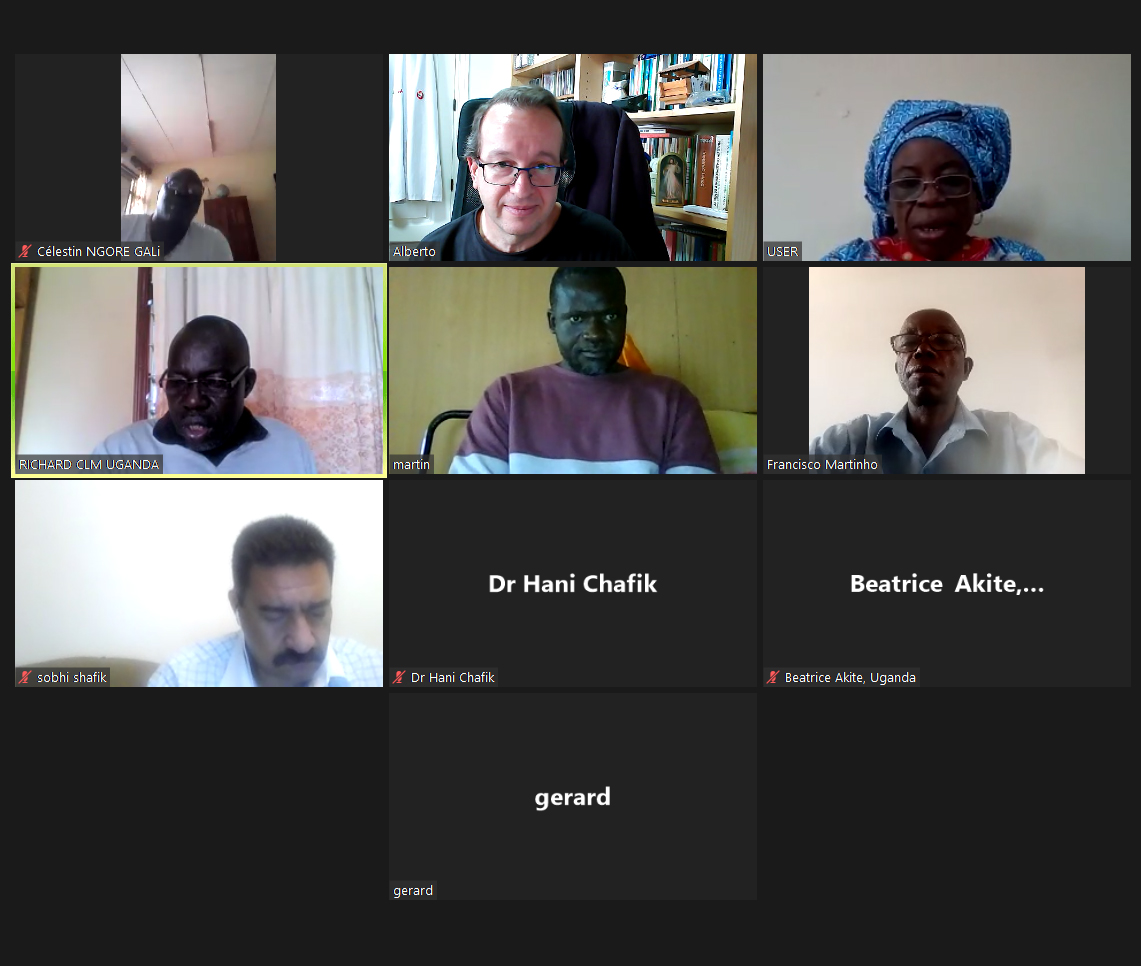
Last January 31 we transmitted live from the Facebook page of the Comboni Lay Missionaries of Portugal: “Missionary Conversations with Ethiopia”. In this conversation between the three CLM, David Aguilera – CLM from Spain – and Pedro Nascimento – CLM from Portugal – shared about the life that sprouts in the mission where they live as a community since 2019 in Ethiopia. They answered questions regarding the response to the call to the missionary vocation, the preparation for their departure to the mission and the experiences and difficulties in the mission.

“For me it was a very nice and intense exchange, also with a special meaning for me, since I also lived that mission for some time and I follow it with my heart and with all the people I met in Ethiopia and in all the way that led me to this mission as a CLM. It is very good to feel that my fellow missionary mates make a beautiful and difficult path, but with the willingness to serve and to let themselves be led by the hands of God”, says Carolina Fiúza, Portuguese CLM who interviews the two CLM, and who was also with them on mission in 2019.

Thus, in the midst of the time of confinement that we live today, to stimulate the ritual of staying at home but with love, we share a missionary testimony that certainly touched many.

CLM Portugal.